Livarix scientific references & ingredient research
Every source below is from an official US government agency or is a research record indexed by the NIH National Library of Medicine. Each one is matched to the Livarix ingredient it discusses, and every link was checked on November 15, 2026.
Government sourceScientific reviewSmall clinical trialLaboratory study
TurmericGovernment fact sheet
NIH · National Center for Complementary and Integrative Health (NCCIH)
Turmeric: Usefulness and Safety
Reviews research on turmeric and curcumin, including studies in fatty liver disease. NCCIH says initial research suggests some measures might improve, but there isn't enough evidence to conclude turmeric is beneficial for any health purpose. It also warns that liver injury has been reported with some highly bioavailable curcumin products.
NIH · NIDDK & National Library of Medicine (LiverTox)
Turmeric (LiverTox record)
LiverTox's clinical record on turmeric's liver safety. Turmeric and curcumin have a long history of safe use, but some turmeric products have been linked to rare cases of clinically apparent liver injury.
NIH · National Center for Complementary and Integrative Health (NCCIH)
Milk Thistle: Usefulness and Safety
Explains that silymarin is milk thistle's main constituent. Results from clinical trials in liver conditions have been conflicting or too limited for conclusions. Milk thistle is generally well tolerated, but it can trigger allergies in people sensitive to the daisy family.
NIH · National Center for Complementary and Integrative Health (NCCIH)
Hepatitis C and Dietary Supplements: What the Science Says
Summarises clinical trials of silymarin. One meta-analysis found only minimal changes in liver enzymes (ALT/AST) without clinical relevance. NCCIH states that no dietary supplement has been shown to be effective for hepatitis C.
NIH · National Center for Complementary and Integrative Health (NCCIH)
Ginger: Usefulness and Safety
Covers ginger's traditional use for indigestion and summarises research, some of it low quality, mostly on nausea. It lists side effects such as abdominal discomfort and heartburn, and advises talking to a provider if you take medicines.
NIH · National Center for Complementary and Integrative Health (NCCIH)
Dandelion: Usefulness and Safety
Notes that very little research exists on dandelion and that there is no compelling evidence for any health condition. Only preliminary lab studies have looked at antioxidant activity. Food amounts are likely safe, and interactions with some medicines are theoretically possible.
NIH · NICHD & National Library of Medicine (LactMed)
Alfalfa – Drugs and Lactation Database (LactMed®)
Describes alfalfa leaf constituents (saponins, isoflavonoids, vitamin K) and notes it is generally recognized as safe as a food. Because of its vitamin K content, it says people taking warfarin should avoid alfalfa.
PubMed · NIH National Library of Medicine research database
Pharmacological Studies of Artichoke Leaf Extract and Their Health Benefits (2015)
A review of laboratory, animal and clinical studies reporting antioxidant, bile-stimulating and liver-protective effects of artichoke leaf extract. Much of the liver evidence comes from animal studies, and the authors describe the research as not yet conclusive.
PubMed · NIH National Library of Medicine research database
Increase in choleresis by means of artichoke extract (1994)
A randomized, placebo-controlled pilot study in 20 people. A single 1.92 g dose of standardized artichoke extract increased bile secretion compared with placebo. That dose is far higher than the 50 mg in Livarix.
PubMed · NIH National Library of Medicine research database
Betanin, a beetroot component, induces Nrf2-mediated expression of detoxifying/antioxidant enzymes in human liver cell lines (2013)
In human liver cell lines, betanin from beetroot activated the Nrf2 pathway and increased Phase II detoxification and antioxidant enzymes. This is laboratory research, not a study in people.
PubMed · NIH National Library of Medicine research database
Regulation of glutathione synthesis (2009)
Explains that glutathione is made from glutamate, cysteine and glycine, and that cysteine availability is a major factor in how much is made. The review covers basic biology and does not test cysteine supplements.
Explains that the FDA does not approve dietary supplements for safety or effectiveness before sale. It describes the risks of combining supplements with medicines and notes that products intended to treat disease are regulated as drugs.
Describes what a Supplement Facts panel must show, explains that the FDA does not test supplements before they are sold, and covers why labels carry the "not evaluated by the FDA" statement.
Please read: these sources discuss individual ingredients, often in different forms and at different doses than in Livarix. They are not studies of Livarix, and none of these agencies has reviewed, endorsed, approved or recommended this product. Laboratory and animal findings are preliminary and don't show the same effect in people. Livarix is not intended to diagnose, treat, cure or prevent any disease.
How to read this page: government fact sheets summarise the overall evidence; reviews pull together many studies; small clinical trials involve few people; laboratory studies use cells or animals and are the most preliminary. For product details, see the ingredient breakdown or the FAQ.
Get started
Ready to make Livarix part of your morning?
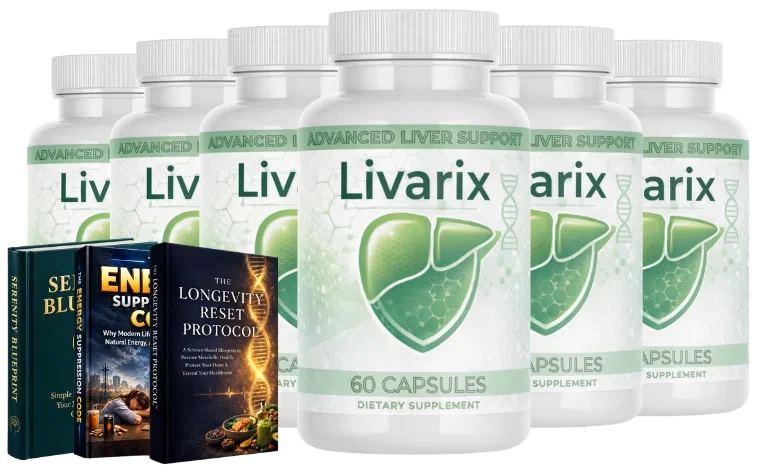
Choose the package that fits your routine. The 6-bottle option has the lowest price per bottle, ships free in the US and includes three bonus e-books.